The World Of Aviation

Welcome To aReJuG's Blog

AREJUG'S BLOG

Welcome TO THE WORLD OF AVIATION www.arejug.blogspot.com

AREJUG'S BLOG

WELCOME TO THE WORLD OF AVIATION www.arejug.blogspot.com

Custom Search

Turtle Airships, Military Blimps, Hybrids, and Civilian Dirigibles

Turtle Airships


Picture
(click to enlarge):

Subjects: Why "turtle"?

Because it has a SHELL. A hard, facted, durable, all weather, strong shell. Unlike blimps or zeppelins; which are built as glorified balloons...which can leak and tear and fall apart in sunlight.

Because it is FAST. The incrongruity of a fast Turtle is meant to surprise and intrique. Blimps and zeppelins are slow because of the flexibility and lack of structural strength of their fabric and laminate envelopes. The Turtle shell makes it strong, rigid......and fast. To 200mph.........

Because it is AMPHIBIOUS. Blimps and zeppelins land and tie up at mooring masts. They need large ground crews to land. The Turtle airship, on the other hand, can land anywhere. It can land on an unprepared field, or land in the water.........just like a turtle.

Because it looks like a turtle. The bow and stern planes give the impression of a turtles' four legs sticking out from its' shell. The position of the three bottom hulls appears much like a turtles' head and forelimbs underneath its' shell.

Because its' "slow, but sure". At one third the speed of a large jet......it is safe and steady. No turbulence. No banking or climbing like an airplane. Quiet. Calm. No jet lag. Comfortable........with walk around room and private staterooms. Totaly safe. No high speed make-or-break approaches to runway landings. No wind shear dangers. Immune to the same bombing, shooting, missiles, or hi-jack attempts that threaten airplanes.

Because it's SOLAR POWERED. Just as a cold blooded turtle climbs out of the water and soaks up the sun.........so Turtle Airships collect sunlight in photovoltaic solar cells in order to generate electricity for power. With fuel cells and a bio-diesel back up capability, it makes the Turtle airship into a truly "green" technology; and changes flight forever.

Because who could ignore, or ever forget......A FLYING TURTLE ??!!


Eco-friendly Turtle Airship design

intro: It certainly doesn’t hurt to have, eco-friendly one like the Turtle Airship that Darrell Campbell, the designer of Millennium Airship is working on. The picture is that of a Millenium Airship.

Subjects: Eco-friendly Features:

• The outer frame-work of the Airship to be made of titanium, aluminum or stainless steel would be incorporated with amorphous thin films of photovoltaic cells to harness solar energy.

• The electricity produced runs the electric motors and propellers of the Airship.

• The electric motors use lighter super conducting magnets rather than copper wires.

• The excess energy produced in the day is used to split water into hydrogen and oxygen, to function as fuel cell as an alternate during night and cloudy conditions.

• Bio-diesel powered generators are also built-in to circumvent any remote chances of solar and fuel cells’ failure.


Millennium Airship, Inc.


Picture (click to enlarge): Millennium Airship, creators of a revolutionary new hybrid heavy lift aircraft, the SkyFreighter.

Intro: Millennium Airship Inc. founded in August 1998. The primary goal of the company is to design, engineer, build, market and operate the world's first HEAVY-LIFT AIR VEHICLE that is: lighter-than-air, all-weather, amphibious semi-rigid, multi-mission, hybrid. The key feature of this aircraft will be in that it is so maneuverable, that it can operate in and out of virtually anywhere (land or sea) where there is enough space to accommodate its size.

Subjects: DARPA (Defence Advanced Research Projects Agency) WALRUS PROJECT

"Fort to the Fight" Unit of Action - At a meeting organized by the Joint Chiefs of Staff, JCS J-4 Mobility Division in April 2001 at the Pentagon, the desire for a prototype demonstration of "SkyFreighter" was requested by all branches attending. We fully believe this airship and it's unique capabilities will provide our Armed Forces with a "mission" diverse transport that can get the troops, armor and supplies to the point of conflict. And, provide Homeland Security Agency with a smaller version of "SkyFreighter" for Extended Duration (3 days) Maritime Coastal Patrol and Drug Interdiction. The military requires an air vehicle that can lift 500 plus tons, cruise at 100 mph, travel 12000 miles in 7 days, and fly at altitudes up to 20,000 feet. The Millennium Airship, Inc DARPA Proposal was mailed on March 30 to DARPA. Even though the DARPA project has been cancelled for now, all branches of the military and Homeland Security have definite requirements for this aircraft.

Benefits

1) Because of its massive lifting capacity, SkyFreighter can bring the "Fort to the Fight."
2) SkyFreighter can land almost anywhere, land or sea. No airport or ground support required.
3) Unlike all other airships, SkyFreighter does not need ballast transference when loading or unloading.


Picture (click to enlarge):

Military Blimps


4 New 'Blimp' Designs Bring Return of the Airship

Picture (click to enlarge): Aeros’s new ballast-free airship design may soon be tested for the Pentagon in a demonstration craft.

Intro: Always on the verge of a seeming comeback, airships are back in the spotlight, touting new technologies. The Defense Advanced Research Project Agency recently announced funding for an innovative, ballast-free airship technology created by Aeros Aeronautical Systems, based outside Los Angeles. The Aeroscraft ML866's potentially revolutionary Control of Static Heaviness system compresses and decompresses helium in the 210-ft.-long envelope, changing this proposed sky yacht's buoyancy during takeoff and landings, Aeros says. It hopes to end the program with a test flight demonstrating the system. Other companies are planning their own first flights within the next few years. Each has a design that it promises will launch a new era of lighter-than-air transportation.


Picture (click to enlarge): HAA


Picture (click to enlarge): SA-60


Picture (click to enlarge): Skycat-20


Boeing to Build SkyHook Neutrally Buoyant Rotorcraft


Picture (click to enlarge): SkyHook Lifting Off (Source: Boeing)

Intro: Boeing and SkyHook International have announced that they intend to team up for a new aircraft called the JHL-40 (Jess Heavy Lifter). The JHL-40 is a new commercial heavy lift aircraft that is intended to transport equipment and materials in remote and harsh regions such as Alaska or the Canadian Arctic.

Boeing will build the JHL-40 neutrally buoyant rotorcraft for SkyHook, which will own, maintain and operate the JHL-40 for commercial clients.


Subjects: The aircraft utilizes a helium filled envelope that provides enough lift to make the JHL-40 aircraft, engines, and crew neutrally buoyant. The four rotors will generate lift that is only needed to support the payload. According to Boeing and SkyHook, the JHL-40 will be able to lift loads as heavy as 40 tons and transport them up to 200 miles without refueling.


Boeing's New Heavy Lifter


Picture (click to enlarge): SkyHook in Transit (Source: Boeing)

Intro: You can bet the Army will be looking into this for their Joint Heavy Lift platform. Believe it or not, something very similar to this is discussed in great detail in the original Defense Science Board report on Sea Basing.

When you start thinking about this technology, and the maturity potential, the absence of a military commitment to date is curious. We tend to think there is a lot of capability here long term.


Picture
(click to enlarge): From Giant Blimp, Deflated [>]. A quote - No! Nooooo! Say it ain't so, Darpa! The Walrus program -- the fringe-science agency's awesomely, almost insanely, ambitious plan to build an aircraft carrier-sized blimp -- is over, Defense Technology International discovers.


Picture
(click to enlarge):

From BAE SYSTEMS FLOATS AUTONOMOUS SYSTEM AT FARNBOROUGH INTERNATIONAL [>]. A quote - A 22 meter long airship, originally developed by balloonist and adventurer Per Lindstrand, could become the latest addition to BAE Systems growing portfolio of autonomous systems. The GA22 airship, perfect for deployment into roles such as communications relay stations, will be updated and adapted to carry payloads, such as high tech surveillance equipment at up to 150 kilograms in weight, to heights of more than 6,500 feet. BAE Systems plan to integrate their existing Unmanned Autonomous Systems into the GA22 making the technology more accessible to potential users.


Picture
(click to enlarge):

From Time for TARS Along USA’s Southern Borders [>]. A quote - An aerostat is a lighter-than-air craft that relies on a ground tether for movement and often for power as well, as opposed to blimps which are self-powered, free-flying craft.


Picture
(click to enlarge):

From Where Did All the Airships Go? [>]. A quote - A few years ago, the Air Force was all excited about "near space," the area between 65,000 and 325,000 feet above sea level. The plan was to put lighter-than-air ships up in this region above the jet stream for persistent surveillance. I, too, got excited, because I love everything and anything to do with lighter-than-air vehicles. But one by one, many of the near space efforts have been killed off or scaled back (although some appear to go on, as Bill Sweetman notes over at Aviation Week's ARES blog).

Hybrid Airships


Airlines.net - Lockheed Martin P-791


Picture (click to enlarge): Picture of the Lockheed Martin P-791 aircraft. (Lockheed Martin's Secretly Built Airship Makes First Flight (Feb 5, 2006) [>])

Intro: N791LM (cn 0001) I was at the Blackbird Air Park when suddenly this black project hybrid airship took off. It has been secretly built by Skunkworks as a heavy-load carrier. To gain more span to act like a wing, the P-791 is three pressurized lobes joined together. It uses four air cushions as landing gear, located on the outer lobes. It appears to have four propellers-two at the tail and two on the sides. A hybrid airship derives most of its lift by lighter-than-air gas, the rest by its shape and span.

Subjects: From Wikipedia [>]: The P-791 is an experimental aerostatic/aerodynamic hybrid airship developed by Lockheed-Martin corporation. The first flight of the P-791 was made on 31 January 2006 at the company's flight test facility on the Palmdale Air Force Plant 42. According to press reports, the designation "P-791" has no particular meaning.

Although Lockheed-Martin is developing a design for the DARPA project WALRUS, the company claims that the P-791 is unrelated to WALRUS. Nonetheless, the design represents an approach that may well be applicable to WALRUS. Some believe that Lockheed-Martin has used the secret P-791 program as a way to get a "head-start" on Worldwide Aeros Corporation, the other Phase I WALRUS competitor.


Picture
(click to enlarge):

From The Hybrid Aircraft Flies - A Press Release According to Aviation Week [>]


Picture
(click to enlarge):

From It's a hovercraft, it's a blimp... [>]. A quote - It's an experimental craft called the P-791, made by Lockheed-Martin. The lumbering take-offs and landings are curious. It's alleged to be over 60 meters (~200 feet) long.

Civilian Dirigibles


Picture
(click to enlarge): From Luxury Airship Filled With Helium, Rich People [>]


Picture
(click to enlarge): From As-Yet Unbuilt Aeroscraft ML866 Nonetheless Officially Launched [>]


Picture
(click to enlarge): From Blimp News! The Strato Cruiser Luxury Blimp Concept Design [>]


Picture
(click to enlarge): From Zeppelins are Back, Too [>]


Picture
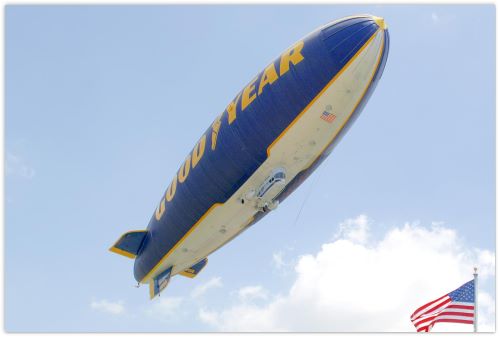
(click to enlarge): From Alameda Naval Air Museum [>]. Goodyear Blimp "Spirit of America" (N10A), Photo by John Shupek


Picture
(click to enlarge): From Horizon blimp one of just 20 in the world [>].The Horizon Blue Cross Blue Shield of New Jersey airship will cruise the state through October.


Picture
(click to enlarge): From The future of hyperblimps (and some necessary background) [>]


Picture
(click to enlarge): From Blimp catches some eyes on Day 1 [>]. DAVID AHNTHOLZ / Daily News. The Ginn Resorts blimp circles over Quail West on Friday during the first round of The ACE Group Classic.


Picture
(click to enlarge): From Inventors to Start Work on Second Personal Blimp [>]


Picture
(click to enlarge): From Seeing London by airship [>] gallery. The Stella Artois Airship, built by Zeppelin, prepares for take-off in Essex. Photograph: Peter Macdiarmid/Getty


Picture
(click to enlarge): From Seeing London by airship [>] gallery.


Picture
(click to enlarge): From Seeing London by airship [>] gallery.


Picture
(click to enlarge): From Seeing London by airship [>] gallery.


Picture
(click to enlarge): From Solar Power Generating Blimp for Disasters [>]

History and Galleries


Picture
(click to enlarge): From Countryman & McDaniel [>]


Picture
(click to enlarge): From Welcome to modern-airships.info [>]


Picture
(click to enlarge): From official website of Goodyear Blimp [>] gallery.


Picture
(click to enlarge): From Alert the amphibious squadron! [>]. A quote - I don’t often link to interesting posts from Modern Mechanix because once you start, where do you stop? But I am compelled to point out this one which reprints an October 1934 Modern Mechanix and Inventions article about an American (presumably) idea for a solar-powered flying airfield.

Airplane Parts Definition And Function ( Part 5 ) - Stabilators


At the rear of the fuselage of most aircraft one finds a horizontal stabilizer and an elevator to provide stability and control of the up-and-down, or pitching, motion of the aircraft nose. On many fighter planes, in order to meet their high maneuvering requirements, the stabilizer and elevator are combined into one large moving surface called a stabilator. Because the stabilator moves, it varies the amount of force generated by the tail surface and is used to generate and control the pitching motion of the aircraft. There is usually a stabilator on each side of the fuselage and they work in pairs; when the right stabilator goes up, the left stabilator also goes up. This slide shows what happens when the pilot deflects the stabilators.

The stabilator is used to control the position of the nose of the aircraft and the angle of attack of the wing. Changing the inclination of the wing to the local flight path changes the amount of lift which the wing generates. This, in turn, causes the aircraft to climb or dive. During take off the stabilators are used to bring the nose of the aircraft up to begin the climb out. During a banked turn, stabilator inputs can increase the lift and cause a tighter turn. That is why stabilator performance is so important for fighter aircraft.

The stabilators work by changing the angle of attack of the horizontal stabilizer. As described on the inclination effects slide, changing the angle of attack of an airfoil changes the amount of lift generated by the foil. With greater downward deflection of the leading edge, lift increases in the downward direction. With greater upward deflection, lift increases in the upward direction. The lift force (F) is applied at the center of pressure of the the stabilator which is some distance (L) from the aircraft center of gravity. This creates a torque

T = F * L

on the aircraft and the aircraft rotates about its center of gravity. The pilot can use this ability to make the airplane loop or dive.

On most aircraft, the horizontal stabilizer and elevator are separate pieces with the elevator being connected to the stabilizer by a hinge. These aircraft rely on changing the shape of the tail airfoil to produce a change in the down force for control. On some aircraft, the pitch stability and control is provided by a canard which is a horizontal surface placed forward of the center of gravity (a tail in the front). The Wright brother's 1903 flyer used a forward elevator for pitch control.


.

AirAsia is Top Brand from Emerging Markets - malaysiakini


KUALA LUMPUR, 7 November 2008 – AirAsia, the leading and largest low-cost carrier in Asia, has been recognized as the ‘top brand to watch’ in the UK Trade & Investment’s New World Brands annual report. AirAsia is the only South East Asian company to make the list of top ten brands from emerging markets across Brazil, Russia, India and China.

New World Brands, which was produced in co-operation with the Economist Intelligence Unit, examines many of the world’s fastest-growing and most innovative companies from emerging markets. AirAsia is ranked

above other successful companies such as Chery Automobile, Haier, Marcopolo, Reliance, and Springs Global.

AirAsia currently flies to more than 60 destinations and boasts the lowest operating cost of any carrier worldwide. The airline has optimised costs by operating a faster turnaround time, improving aircraft utilization and crew efficiency, and providing a pay-per-use passenger service, all of whi

ch results in savings which are passed back to consumers in the form of low fares.

Dato’ Sri Tony Fernandes, AirAsia Group CEO, said: “This is a great achievement for AirAsia to be recognized as a top new world brand and reflects our hard work and pioneering attitude to make air travel an affordable reality for everyone across Asia. We always focused on being a global brand and the investment is now beginning to reap the rewards.”

According to the report, leading brands from emerging markets are “shaking up industries” and challenging conventional business wisdom while benchmarking themselves against global standards.

Tony Fernandes added: “Despite the current challenging market conditions, AirAsia is still going strong. We have successful joint ventures in Thailand and Indonesia, as well as AirAsia X, the low-cost, long-haul subsidiary of AirAsia. Our fleet in Malaysia has been fully upgraded with the more modern Airbus A320s. We are vigilant in our efforts to maintain AirAsia’s notoriously low fares, and our disciplined low-cost model sets a global standard for airline efficiency.”

AirAsia was also rec

ently ranked Top 5 among Asia Pacific’s airline brands, ahead of Malaysia Airlines and Qantas, among others, in the Top 1000 Brands 2008 survey conducted by TNS for Hong Kong-based Media magazine.


.


Aircraft Winglets

Many of us who fly regularly have most probably seen a so-called winglet or wingtip device at the end of the wing of an airliner at least once. It is showing up more and more often on more and more types of aircraft, thus we felt it’s time to give an overview to our readers about these sometimes funny, sometimes cool and stylish looking aircraft parts.

Winglet on Virgin Atlantic A340-600 - c by Dan Valentine on Airliners.net

Winglet on Virgin Atlantic A340-600 - c by Dan Valentine on Airliners.net

History, Reason and Benefits

The initial theoretical concept goes back to times before even the Wright Brothers first took to the skies in 1905, but it was picked up and developed by Richard T. Whitcomb of NASA after the 1973 oil crisis - in order to reduce fuel consumption. The first tests were carried out in 1979/80 in cooperation with the U.S. Air Force. At almost the same time, but independent of any U.S. military organization, a private jet producer, LearJet exhibited a prototype in 1977: the LearJet 28 that featured the first winglets on a jet and a production aircraft. Flight tests made with and without winglets showed that the winglets increased range by about 6.5 percent and also improved directional stability for the LearJet- these two factors are the major reasons behind using this facility at any fixed wing aircraft ever since.

Airflow around the wingtip with or without a wingletA winglet is a (near) vertical extension of the wing tips. The upward angle of the winglet, its inward angle as well as its size and shape are critical for correct performance - this is why they can look quite different. Air rotating around the wing strikes the surface of the winglet that directs it in another direction - thus creating an extra force, basically converting otherwise wasted energy to thrust. This is a small contribution but can save a lot for an operator in an aircraft’s lifetime. Another potential benefit of winglets is that they reduce the strength of wingtip vortices, which trail behind the plane. When other aircraft pass through these vortices, the turbulent air can cause loss of control, possibly resulting in an accident.

Winglet Types

In general any wingtips that not end the wing simply horizontally are considered as some kind of a winglet. Even though in strictly technical terms Wingtip Fences are not real extensions of the wing, and Raked Wingtips do not have a vertical part, they are still widely considered as winglet variants.

WINGTIP FENCES are a special variant of winglets, that extend both upward and downward from the tip of the wing. Preferred by European plane-maker Airbus, it is featured on their full product range (except the A330/340 family and the future A350). The Airbus A300 was actually the first jet airliner to feature this kind of solution by default, but it was a very small version of the tool. Provided that most of the Airbus planes (including all A320 family jets) feature such wingtip fences, this may be the most seen and most produced winglet type. Even the new Airbus A380 double-decker features wingtip fences.

Airbus Winglets as seen from the outside

Airbus Winglets as seen from the outside

Airbus Winglets seen from onboard

Airbus Winglets as seen from onboard

BLENDED WINGLETS (the real “Winglets”) are the most popular winglet type, leveraged by Airbus, Boeing, Embraer, Bombardier but also by Russian Tupolev and Iljushin. Blended winglets were first introduced on the McDonnel Douglas MD-11 aircraft in 1990 with launch customer Finnair (it also features a smaller winglet at the bottom side of the wing). In contrast to Airbus who applies the wingtip fences by default on most of their aircraft (and the winglets on the A330/340 family), blended winglets are considered by Boeing for example as an optional extra feature on their products, except for the Boeing 747-400. For some of the older Boeing jets (737 and 757) such blended winglets have been offered as an aftermarket retrofit, these are the newer, tall designs and do not connect to the tip of the wing with a sharp angle, but with a curve instead. These winglets are popular among airlines that fly these aircraft on medium/long haul routes as most of the real fuel savings materialize while cruising. Longer flights mean longer cruising, thus larger fuel savings. And they also server as marketing surface for airline logos or web addresses usually.

Just recently the Boeing 767-300ER has received 3.4 m high (!) winglets produced by Aviation Partners Inc. with American Airlines as the launch-customer with Air New Zealand and Hawaiian Airlines following with orders of 5 and 8 aircrafts respectively. 141 shipsets have been pre-sold already as the forecasted fuel savings range around 4%-6% for medium/long-range flights. Airbus earlier tested similar blended winglets designed by Winglet Technology for the A320 series, but determined that their benefits did not warrant further development and they stayed with the wingtip fences instead. Aviation Partners Boeing claims that winglets on 737s and 757s have saved a collective 1.2 billion gal. of fuel since they were introduced and 11.5 million tonnes of CO2 while reducing those types’ noise footprint by 6.5%. It has sold winglets to 140 airlines and 95% of all 737NGs are fitted with them. It is working on four winglet concepts for the 777 and hopes to finalize a design for that aircraft type by December, 2008.

Blended Winglets on Several Aircraft Types

Blended Winglets on Several Aircraft Types

RAKED WINGTIPS are the most recent winglet variants (they are probably better classified as special wings, though), where the tip of the wing has a higher degree of sweep than the rest of the wing. They are widely referred to as winglets, but they are better described as integrated wingtip extensions as they are (horizontal) additions to the existing wing, rather than the previously described (near) vertical solutions. The stated purpose of this additional feature is to improve fuel economy, climb performance and to shorten takeoff field length. It does this in much the same way as “traditional” winglets do. In testing by Boeing and NASA, raked wingtips have been shown to reduce drag by as much as 5.5%, as opposed to improvements of 3.5% to 4.5% from conventional winglets. Airliners to use raked wingtips: Boeing 747-8, Boeing 767-400ER, Boeing 777(-200LR; -300ER; and freighter versions) plus the new Boeing 787 Dreamliner and the Airbus A350. The 747-8, the 787 and the A350 will have special, new kind of wings, which do not have a separate winglet, but have raked, and blended wingtips integrated - without a sharp angle between the wing and the winglet.

Raked Wingtips on the new Boeing 787 and Airbus A350

Raked Wingtips on the new Boeing 787 and Airbus A350

As you can see, wingtips/winglets have developed and changed very much over the last 30 years, but are becoming the standard, which is not proven better by anything else than the wing designs of future aircraft by the largest airplane-makers that feature a built-in winglet at the tip of their new, revolutionary wings.


No Problems For Airlines To Reduce Surcharges If Global Oil Prices Are Stable, Says Lajim - malaysiakini


Malaysian Airline System Bhd (MAS) and AirAsia Bhd have no problems reducing their fuel surcharges if the global oil prices are stable, said Deputy Transport Minister, Datuk Seri Panglima Lajim Ukin.

"AirAsia still imposes a fuel surcharge of RM50 and MAS RM60 because the global oil prices are still not stable," he said in reply to a question from Hiew King Cheu (BN-Kota Kinabalu) at Dewan Rakyat here today.

Hiew wanted to know why the two airlines' fuel charges had not been reduced when the global oil prices had gone down.

Lajim said at one time the surcharge for flights between Malaysia and South Korea had rose to US$98 but now had been reduced to US$62.


Airasia X Plans Destinations In Europe And India For Airbus A330 - malaysiakini


SEPANG, -- AirAsia X, the long-haul affiliate of low-cost airline AirAsia Bhd, plans to expand its destinations to Europe, including the United Kingdom, by March next year and also fly to 10 cities in India in the next five years.

These routes would be served by the new Airbus A330 aircraft that the carrier had ordered, said chief executive officer Azran Osman Rani.

AirAsia X has received its first 25 new Airbus A330 last Saturday, and more are scheduled to arrive from end of this year until 2013.

"There is an opportunity now to accelerate on the orders because some airlines are deferring their orders for financing reasons. If we can get the aircraft sooner, we can open up more routes faster," he told reporters after celebrating the airline's first anniversary at the Low-Cost Carrier Terminal here, Monday.

Azran said the airline aimed to cover destinations which are more than four hours in flight duration from Kuala Lumpur, completing the existing AirAsia network.

The 25 new Airbus A330 aircraft ordered by AirAsia X together with AirAsia Bhd's order of 175 aircraft were estimated at a value of about US$6.6 billion.

According to Azran, AirAsia X is confident that it will be able to source the fund to finance the order given its positive cashflow.

"We have already generate positive cashflow since April this year and this is the reason why we managed to convince the finance institution," he said.

The airline, he added, had clinched the deal to finance the first few planes and would talk with banks, both local and foreign, for the other aircraft.

In conjunction with AirAsia Xs first anniversary, the airline will be giving away free seats to all its destination, including the Gold Goast, Perth and Melbourne in Australia and Hangzhou in China.

Launched in January 2007, the company currently flies four times weekly to the Gold Coast, six times weekly to Perth and five times weekly to Hangzhou.


CAP 393 : AIR NAVIGATION ORDER ( ANO )


CAP 393

AIR NAVIGATION: THE ORDER AND THE REGULATIONS


.

Airplane Parts Definition And Function ( Part 4 ) - Horizontal Stabilizer - Elevator


At the rear of the fuselage of most aircraft one finds a horizontal stabilizer and an elevator. The stabilizer is a fixed wing section whose job is to provide stability for the aircraft, to keep it flying straight. The horizontal stabilizer prevents up-and-down, or pitching, motion of the aircraft nose. The elevator is the small moving section at the rear of the stabilizer that is attached to the fixed sections by hinges. Because the elevator moves, it varies the amount of force generated by the tail surface and is used to generate and control the pitching motion of the aircraft. There is an elevator attached to each side of the fuselage. The elevators work in pairs; when the right elevator goes up, the left elevator also goes up. This slide shows what happens when the pilot deflects the elevator.

The elevator is used to control the position of the nose of the aircraft and the angle of attack of the wing. Changing the inclination of the wing to the local flight path changes the amount of lift which the wing generates. This, in turn, causes the aircraft to climb or dive. During take off the elevators are used to bring the nose of the aircraft up to begin the climb out. During a banked turn, elevator inputs can increase the lift and cause a tighter turn. That is why elevator performance is so important for fighter aircraft.

The elevators work by changing the effective shape of the airfoil of the horizontal stabilizer. As described on the shape effects slide, changing the angle of deflection at the rear of an airfoil changes the amount of lift generated by the foil. With greater downward deflection of the trailing edge, lift increases. With greater upward deflection of the trailing edge, lift decreases and can even become negative as shown on this slide. The lift force (F) is applied at center of pressure of the horizontal stabilzer which is some distance (L) from the aircraft center of gravity. This creates a torque

T = F * L

on the aircraft and the aircraft rotates about its center of gravity. The pilot can use this ability to make the airplane loop. Or, since many aircraft loop naturally, the deflection can be used to trim or balance the aircraft, thus preventing a loop. If the pilot reverses the elevator deflection to down, the aircraft pitches in the opposite direction.

On many fighter planes, in order to meet their high maneuvering requirements, the stabilizer and elevator are combined into one large moving surface called a stabilator. The change in force is then created by changing the inclination of the entire surface, not by changing its effective shape as is done with an elevator. On some aircraft, the pitch stability and control is provided by a horizontal surface placed forward of the center of gravity (a tail in the front). This surface is called a canard. The name is the French word for duck and it is used because the shape when viewed from above resembles a duck with bulges near the neck.


Civil Aviation Inspection Procedure ( CAIPs )


CAIPs are now available here as a Soft Copy.

These are the Civil Aircraft Inspection Procedures (CAIPs) which are no longer published by the CAA.

Together with the new version CAAIPs, these are the most essential publications for your Part-66 studies. In Module 7 for example, these CAIPs will answer about 80% of the questions. They are essential reading material for Modules 2,3,4,5,6,7,11,12,13,14,15,16 and 17

CAIPs are not printed by the CAA any longer. They are technically obsolete for use in aircraft maintenance and have been replaced by the new CAAIPs, which are updated regularly and which are free to download from the CAA website (see below).

The electronic versions is in one indexed file, each page a high definition scan. You can print from the electronic versions or use to read from your screen. Each chapter is indexed.

This version of CAIPs is the last version to be produced by the CAA before they were withdrawn from print. They include the chapters, and sections of chapters which are omitted from other copies of CAIPs commercially available on the internet. They do not include very old chapters long since withdrawn by the CAA, and which are not used by the CAA examiners to select CAA questions. They also do not include the chapters on aircraft regulations - which have long since been obsolescent, and are replaced with updated versions in the new CAAIPs freely available (see the CAA website).


The CAIP is available to be downloaded here:

CAIP Part 1: http://www.ziddu.com/download/3250095/CAIPPartI.pdf.html

CAIP Part 2: http://www.ziddu.com/download/3250223/CAIPPartII.pdf.html


different paths

college campus lawn

wires in front of sky

aerial perspective

clouds

clouds over the highway

The Poultney Inn

apartment for rent