The World Of Aviation

Welcome To aReJuG's Blog

AREJUG'S BLOG

Welcome TO THE WORLD OF AVIATION www.arejug.blogspot.com

AREJUG'S BLOG

WELCOME TO THE WORLD OF AVIATION www.arejug.blogspot.com

Custom Search

Aircraft Winglets

Many of us who fly regularly have most probably seen a so-called winglet or wingtip device at the end of the wing of an airliner at least once. It is showing up more and more often on more and more types of aircraft, thus we felt it’s time to give an overview to our readers about these sometimes funny, sometimes cool and stylish looking aircraft parts.
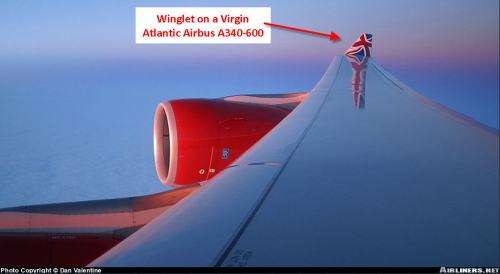
Winglet on Virgin Atlantic A340-600 - c by Dan Valentine on Airliners.net

Winglet on Virgin Atlantic A340-600 - c by Dan Valentine on Airliners.net

History, Reason and Benefits

The initial theoretical concept goes back to times before even the Wright Brothers first took to the skies in 1905, but it was picked up and developed by Richard T. Whitcomb of NASA after the 1973 oil crisis - in order to reduce fuel consumption. The first tests were carried out in 1979/80 in cooperation with the U.S. Air Force. At almost the same time, but independent of any U.S. military organization, a private jet producer, LearJet exhibited a prototype in 1977: the LearJet 28 that featured the first winglets on a jet and a production aircraft. Flight tests made with and without winglets showed that the winglets increased range by about 6.5 percent and also improved directional stability for the LearJet- these two factors are the major reasons behind using this facility at any fixed wing aircraft ever since.

Airflow around the wingtip with or without a wingletA winglet is a (near) vertical extension of the wing tips. The upward angle of the winglet, its inward angle as well as its size and shape are critical for correct performance - this is why they can look quite different. Air rotating around the wing strikes the surface of the winglet that directs it in another direction - thus creating an extra force, basically converting otherwise wasted energy to thrust. This is a small contribution but can save a lot for an operator in an aircraft’s lifetime. Another potential benefit of winglets is that they reduce the strength of wingtip vortices, which trail behind the plane. When other aircraft pass through these vortices, the turbulent air can cause loss of control, possibly resulting in an accident.

Winglet Types

In general any wingtips that not end the wing simply horizontally are considered as some kind of a winglet. Even though in strictly technical terms Wingtip Fences are not real extensions of the wing, and Raked Wingtips do not have a vertical part, they are still widely considered as winglet variants.

WINGTIP FENCES are a special variant of winglets, that extend both upward and downward from the tip of the wing. Preferred by European plane-maker Airbus, it is featured on their full product range (except the A330/340 family and the future A350). The Airbus A300 was actually the first jet airliner to feature this kind of solution by default, but it was a very small version of the tool. Provided that most of the Airbus planes (including all A320 family jets) feature such wingtip fences, this may be the most seen and most produced winglet type. Even the new Airbus A380 double-decker features wingtip fences.

Airbus Winglets as seen from the outside

Airbus Winglets as seen from the outside

Airbus Winglets seen from onboard

Airbus Winglets as seen from onboard

BLENDED WINGLETS (the real “Winglets”) are the most popular winglet type, leveraged by Airbus, Boeing, Embraer, Bombardier but also by Russian Tupolev and Iljushin. Blended winglets were first introduced on the McDonnel Douglas MD-11 aircraft in 1990 with launch customer Finnair (it also features a smaller winglet at the bottom side of the wing). In contrast to Airbus who applies the wingtip fences by default on most of their aircraft (and the winglets on the A330/340 family), blended winglets are considered by Boeing for example as an optional extra feature on their products, except for the Boeing 747-400. For some of the older Boeing jets (737 and 757) such blended winglets have been offered as an aftermarket retrofit, these are the newer, tall designs and do not connect to the tip of the wing with a sharp angle, but with a curve instead. These winglets are popular among airlines that fly these aircraft on medium/long haul routes as most of the real fuel savings materialize while cruising. Longer flights mean longer cruising, thus larger fuel savings. And they also server as marketing surface for airline logos or web addresses usually.

Just recently the Boeing 767-300ER has received 3.4 m high (!) winglets produced by Aviation Partners Inc. with American Airlines as the launch-customer with Air New Zealand and Hawaiian Airlines following with orders of 5 and 8 aircrafts respectively. 141 shipsets have been pre-sold already as the forecasted fuel savings range around 4%-6% for medium/long-range flights. Airbus earlier tested similar blended winglets designed by Winglet Technology for the A320 series, but determined that their benefits did not warrant further development and they stayed with the wingtip fences instead. Aviation Partners Boeing claims that winglets on 737s and 757s have saved a collective 1.2 billion gal. of fuel since they were introduced and 11.5 million tonnes of CO2 while reducing those types’ noise footprint by 6.5%. It has sold winglets to 140 airlines and 95% of all 737NGs are fitted with them. It is working on four winglet concepts for the 777 and hopes to finalize a design for that aircraft type by December, 2008.

Blended Winglets on Several Aircraft Types

Blended Winglets on Several Aircraft Types

RAKED WINGTIPS are the most recent winglet variants (they are probably better classified as special wings, though), where the tip of the wing has a higher degree of sweep than the rest of the wing. They are widely referred to as winglets, but they are better described as integrated wingtip extensions as they are (horizontal) additions to the existing wing, rather than the previously described (near) vertical solutions. The stated purpose of this additional feature is to improve fuel economy, climb performance and to shorten takeoff field length. It does this in much the same way as “traditional” winglets do. In testing by Boeing and NASA, raked wingtips have been shown to reduce drag by as much as 5.5%, as opposed to improvements of 3.5% to 4.5% from conventional winglets. Airliners to use raked wingtips: Boeing 747-8, Boeing 767-400ER, Boeing 777(-200LR; -300ER; and freighter versions) plus the new Boeing 787 Dreamliner and the Airbus A350. The 747-8, the 787 and the A350 will have special, new kind of wings, which do not have a separate winglet, but have raked, and blended wingtips integrated - without a sharp angle between the wing and the winglet.

Raked Wingtips on the new Boeing 787 and Airbus A350

Raked Wingtips on the new Boeing 787 and Airbus A350

As you can see, wingtips/winglets have developed and changed very much over the last 30 years, but are becoming the standard, which is not proven better by anything else than the wing designs of future aircraft by the largest airplane-makers that feature a built-in winglet at the tip of their new, revolutionary wings.


No Problems For Airlines To Reduce Surcharges If Global Oil Prices Are Stable, Says Lajim - malaysiakini


Malaysian Airline System Bhd (MAS) and AirAsia Bhd have no problems reducing their fuel surcharges if the global oil prices are stable, said Deputy Transport Minister, Datuk Seri Panglima Lajim Ukin.

"AirAsia still imposes a fuel surcharge of RM50 and MAS RM60 because the global oil prices are still not stable," he said in reply to a question from Hiew King Cheu (BN-Kota Kinabalu) at Dewan Rakyat here today.

Hiew wanted to know why the two airlines' fuel charges had not been reduced when the global oil prices had gone down.

Lajim said at one time the surcharge for flights between Malaysia and South Korea had rose to US$98 but now had been reduced to US$62.


Airasia X Plans Destinations In Europe And India For Airbus A330 - malaysiakini


SEPANG, -- AirAsia X, the long-haul affiliate of low-cost airline AirAsia Bhd, plans to expand its destinations to Europe, including the United Kingdom, by March next year and also fly to 10 cities in India in the next five years.

These routes would be served by the new Airbus A330 aircraft that the carrier had ordered, said chief executive officer Azran Osman Rani.

AirAsia X has received its first 25 new Airbus A330 last Saturday, and more are scheduled to arrive from end of this year until 2013.

"There is an opportunity now to accelerate on the orders because some airlines are deferring their orders for financing reasons. If we can get the aircraft sooner, we can open up more routes faster," he told reporters after celebrating the airline's first anniversary at the Low-Cost Carrier Terminal here, Monday.

Azran said the airline aimed to cover destinations which are more than four hours in flight duration from Kuala Lumpur, completing the existing AirAsia network.

The 25 new Airbus A330 aircraft ordered by AirAsia X together with AirAsia Bhd's order of 175 aircraft were estimated at a value of about US$6.6 billion.

According to Azran, AirAsia X is confident that it will be able to source the fund to finance the order given its positive cashflow.

"We have already generate positive cashflow since April this year and this is the reason why we managed to convince the finance institution," he said.

The airline, he added, had clinched the deal to finance the first few planes and would talk with banks, both local and foreign, for the other aircraft.

In conjunction with AirAsia Xs first anniversary, the airline will be giving away free seats to all its destination, including the Gold Goast, Perth and Melbourne in Australia and Hangzhou in China.

Launched in January 2007, the company currently flies four times weekly to the Gold Coast, six times weekly to Perth and five times weekly to Hangzhou.


CAP 393 : AIR NAVIGATION ORDER ( ANO )


CAP 393

AIR NAVIGATION: THE ORDER AND THE REGULATIONS


.

Airplane Parts Definition And Function ( Part 4 ) - Horizontal Stabilizer - Elevator


At the rear of the fuselage of most aircraft one finds a horizontal stabilizer and an elevator. The stabilizer is a fixed wing section whose job is to provide stability for the aircraft, to keep it flying straight. The horizontal stabilizer prevents up-and-down, or pitching, motion of the aircraft nose. The elevator is the small moving section at the rear of the stabilizer that is attached to the fixed sections by hinges. Because the elevator moves, it varies the amount of force generated by the tail surface and is used to generate and control the pitching motion of the aircraft. There is an elevator attached to each side of the fuselage. The elevators work in pairs; when the right elevator goes up, the left elevator also goes up. This slide shows what happens when the pilot deflects the elevator.

The elevator is used to control the position of the nose of the aircraft and the angle of attack of the wing. Changing the inclination of the wing to the local flight path changes the amount of lift which the wing generates. This, in turn, causes the aircraft to climb or dive. During take off the elevators are used to bring the nose of the aircraft up to begin the climb out. During a banked turn, elevator inputs can increase the lift and cause a tighter turn. That is why elevator performance is so important for fighter aircraft.

The elevators work by changing the effective shape of the airfoil of the horizontal stabilizer. As described on the shape effects slide, changing the angle of deflection at the rear of an airfoil changes the amount of lift generated by the foil. With greater downward deflection of the trailing edge, lift increases. With greater upward deflection of the trailing edge, lift decreases and can even become negative as shown on this slide. The lift force (F) is applied at center of pressure of the horizontal stabilzer which is some distance (L) from the aircraft center of gravity. This creates a torque

T = F * L

on the aircraft and the aircraft rotates about its center of gravity. The pilot can use this ability to make the airplane loop. Or, since many aircraft loop naturally, the deflection can be used to trim or balance the aircraft, thus preventing a loop. If the pilot reverses the elevator deflection to down, the aircraft pitches in the opposite direction.

On many fighter planes, in order to meet their high maneuvering requirements, the stabilizer and elevator are combined into one large moving surface called a stabilator. The change in force is then created by changing the inclination of the entire surface, not by changing its effective shape as is done with an elevator. On some aircraft, the pitch stability and control is provided by a horizontal surface placed forward of the center of gravity (a tail in the front). This surface is called a canard. The name is the French word for duck and it is used because the shape when viewed from above resembles a duck with bulges near the neck.


Civil Aviation Inspection Procedure ( CAIPs )


CAIPs are now available here as a Soft Copy.

These are the Civil Aircraft Inspection Procedures (CAIPs) which are no longer published by the CAA.

Together with the new version CAAIPs, these are the most essential publications for your Part-66 studies. In Module 7 for example, these CAIPs will answer about 80% of the questions. They are essential reading material for Modules 2,3,4,5,6,7,11,12,13,14,15,16 and 17

CAIPs are not printed by the CAA any longer. They are technically obsolete for use in aircraft maintenance and have been replaced by the new CAAIPs, which are updated regularly and which are free to download from the CAA website (see below).

The electronic versions is in one indexed file, each page a high definition scan. You can print from the electronic versions or use to read from your screen. Each chapter is indexed.

This version of CAIPs is the last version to be produced by the CAA before they were withdrawn from print. They include the chapters, and sections of chapters which are omitted from other copies of CAIPs commercially available on the internet. They do not include very old chapters long since withdrawn by the CAA, and which are not used by the CAA examiners to select CAA questions. They also do not include the chapters on aircraft regulations - which have long since been obsolescent, and are replaced with updated versions in the new CAAIPs freely available (see the CAA website).


The CAIP is available to be downloaded here:

CAIP Part 1: http://www.ziddu.com/download/3250095/CAIPPartI.pdf.html

CAIP Part 2: http://www.ziddu.com/download/3250223/CAIPPartII.pdf.html


Sec-Gen Skips PAC Hearing On Eurocopter Deal - malaysiakini


KUALA LUMPUR, Oct 30 -- The Public Accounts Committee (PAC) has put off its hearing on the Eurocopter deal after the Finance Ministry secretary-general did not turn up.

PAC chairman Datuk Seri Azmi Khalid said that Thursday's hearing was supposed to discuss the financial aspect of the helicopter purchase but in less than one hour, it had to be postponed because the ministry was only represented by a low-rank officer, namely the under-secretary.

"The person's position is high but not as high as the officer we want; we want the Finance Ministry secretary-general himself to be present.

"This is because as custodian in purchase transactions, finances and so on, the responsibility is on the Finance Ministry secretary-general. So, we postponed today's hearing to Monday, Nov 3," he told reporters at the Parliament lobby.

He said the PAC viewed the matter seriously because the helicopter purchase was a high-profile issue and required the top-level officer to be present to give explanation during which the officer may be assisted by his subordinates.

Asked whether the secretary-general gave any excuse for his failure to turn up, Azmi said the excuse given was not very convincing.

He said that on Monday, the PAC would also recall the Defence Ministry Technical Division because there were several issues that need to be answered by the people responsible.

He said that at this stage, the PAC saw no necessity to summon the prime minister or his deputy to give briefing regarding the purchase.


Meanwhile, opposition leader Datuk Seri Anwar Ibrahim called for the setting up of an independent commission to probe into the helicopter purchase.

Establishing the independent commission was the only transparent way in dealing with the issue, he told reporters at the Parliament lobby.


Deferment Does Not Mean Cancellation, Says PAC Chairman - malaysiakini


KUALA LUMPUR, Oct 29 -- The Public Accounts Committee (PAC) is going ahead with the meeting to scrutinise the proposed purchase of Eurocopter helicopters as the deal in still on the table.

PAC chairman Datuk Seri Azmi Khalid said the deferment of the purchase of 12 Eurocopter EC725 Cougar helicopters to replace the ageing Nuri aircraft did not mean that the government was cancelling the deal.

"It's a deferment... it's not a question of cancelling the deal. Deferment is not cancellation," said Azmi when asked on the rationale of the PAC meeting when the government had already announced that the deal had been put on hold.

Earlier the PAC received a briefing on the acquisition of the EC725 helicopters following outcry among certain quarters that the price was exorbitant.

Azmi said the briefing was organised by the Defence Ministry and attended by the ministry's Secretary-General Datuk Abu Bakar Abdullah and Royal Malaysian Air Force Chief Gen Tan Sri Azizan Ariffin.

"We do our part, which is within the framework of our duty as the PAC committee. We have everybody here together with opposition members.

"Today (the meeting) is on the technical side (of the deal); tomorrow, it's on the financial aspect. We will only get the overall picture after the briefings," he said.

Azmi said the tender process for the helicopter was still at an early stage.

"A letter of intent is just an intent. It's not even an order; it's only an intention to buy," he said, referring to the letter of intent which the Finance Ministry had issued to Eurocopter.

He said that the deal had not reached the price negotiation stage yet.

Prime Minister Datuk Seri Abdullah Ahmad Badawi announced on Tuesday that the government had put on hold the purchase of the helicopters at a cost of RM1.679 billion until the global economic situation stabilised.

Abdullah said that the government had to focus its attention on more important projects which would directly benefit the people.

The PAC meeting continues tomorrow.


AirAsia Offers Free Seats To Singapore - malaysiakini


KUALA LUMPUR, Oct 28 -- Asia's largest low-cost airline, AirAsia, is launching a free seat campaign to celebrate its newly added frequencies and services to Singapore from East and West Malaysia, Thailand and Indonesia.

"We are thrilled to be adding frequencies and introducing new services to Singapore.Giving out free seats to our customers is the perfect way to share the excitement with them," Regional Head of Commercial AirAsia, Kathleen Tan said in a statement Tuesday.

To celebrate, the airline is giving away free seats to Singapore from Kuala Lumpur, Kota Kinabalu, Kuching, Pekanbaru, Phuket and Bangkok.

Customers only have to bear the fuel surcharges, airport tax and admin cost.

The free seat promotion will commence on Oct 29-Nov 2 for the travel period of Dec 1, 2008-July 31, 2009.

"While other airlines are cutting back on routes, we are expanding and have the ability to service the underserved markets," she added.

This offer is available exclusively via online at AirAsia's website at www.airasia.com.


Petronas Deepavali 2008 Ads

AirAsia Further Improves 5-Star Service Quality Upgrades On-Time Guarantee to 2 Hours - malaysiakini


KUALA LUMPUR, 23 October 2008 – At last a low cost carrier that can compete with full service airlines but still has low fares – AirAsia.

AirAsia, the leading and largest low cost carrier in Asia, adds another sparkle to its already 5-star service by enhancing its On-Time Guarantee, an innovative protection provided by the airline for guests who are affected by flight delays.

Beginning 1 November 2008, the AirAsia On-Time Guarantee cuts its waiting time from three to two hours, making guests affected by flight delays of more than two hours eligible to receive an e-gift voucher. Each e-gift voucher is worth RM200 and may be used to buy a seat on another AirAsia flight or redeemed for any AirAsia product or service.

Commenting on the upgraded On-Time Guarantee, AirAsia Group Chief Executive Officer Dato’ Sri Tony Fernandes said: “The gap between us and full-service airlines has narrowed from our first day and I dare say we are better than many of them. AirAsia no more has to play second fiddle. We have as good, if not better, service than many other airlines.”

The enhanced On-Time Guarantee is a benefit passed on to AirAsia guests as a result of the airline’s improved on-time performance for flights across its entire network. In just a matter of three months since the AirAsia On-Time Guarantee was launched in June this year, the number of AirAsia flights that were delayed by an hour or more has dropped from 3% in July and 4% in August to 2% in September. As a direct effect, AirAsia has seen its on-time performance for flight departures improving from 89% in July and 85% in August to 90% in September.

On-time performance of flights refers to the departure of flights within 15 minutes of their scheduled departure times. AirAsia is the only airline in the world that provides its guests an innovative protection like the On-Time Guarantee.

AirAsia flies an average of 12,000 flights every month on over 100 routes covering more than 60 destinations in South East Asia and China.

Tony said: “The enhancement of AirAsia’s On-Time Guarantee shows our commitment to deliver 5-star service to our guests. It also highlights our confidence in our ability to fly our guests on time without compromising safety and quality of service. As AirAsia grows, our guests’ expectations also grow, and we are determined to not only meet but surpass these expectations. The enhanced On-Time Guarantee is our commitment to our guests, who have enabled us to grow into the leading low-cost carrier in Asia Pacific.”

“With AirAsia, guests can enjoy low fares and at the same time experience 5-star service at an altitude of 30,000 feet. Now we can offer this enhanced On-Time Guarantee with our other 5-star offerings - brand new Airbus A320 aircraft with leather seats, fun and friendly cabin crew and ground staff, a vast array of food selections, largest number of destinations, highest flight frequencies to individual destinations, and a 5-star smile that allows us to challenge the best of premium airlines. There’s no reason for not flying with AirAsia, even as we embrace an economic slowdown,” he added.

“That the enhancement of our On-Time Guarantee is closely tied with our improved on-time performance for flights shows us in AirAsia that the more efficient we are, the more we can give back to our guests. I am confident that knowledge of this will drive all of us at AirAsia to strive for better efficiency in the airline while delivering superior quality service to our guests,” said Tony.

AirAsia has recently been ranked Top 5 among the most recognized and admired airline brands in the Asia-Pacific region in a survey conducted by leading market research company TNS. Notably, AirAsia was the only low-cost carrier to be listed among the ‘Top 10 Asia-Pacific Airlines’, which saw it coming ahead of other full-service, legacy carriers including Qantas and Malaysia Airlines.

AirAsia X Set To Take Delivery Of New Airbus A330 - REF MALAYSIAKINI


KUALA LUMPUR, Oct 21 - Friday, Oct 31 marks yet another significant milestone for AirAsia when its low-cost long-haul affiliate, AirAsia X takes delivery of the first brand new Airbus A330, which is expected to reduce the airlines fuel consumption and maintenance costs.

The handing over ceremony comes more than three weeks after AirAsia bade farewell to the final Boeing 737-300 aircraft on its Malaysian operations. The low-cost short-haul airline, has now switched to Airbus A320 fleet, which is expected to help the airline save through fuel efficiency.

A group of Malaysian journalists who are on this assignment, will return to Kuala Lumpur on this ferry flight (inaugural flight) on board the new A330-300 on the same day, after the official hand-over in Toulouse, France.

Toulouse, dubbed Ville Rose ("Pink City") because of its distinctive pink buildings, is the aircraft manufacturers headquarters.

AirAsia X, whose shareholders include the Virgin Group of U.K., is helmed by its 36-year old Chief Executive Officer Azran Osman-Rani, previously Senior Director of Business Development at private satellite TV operator Astro, with key team members, comprising young, driven and dynamic individuals, having a wealth of experience in the aviation industry.

"The new A330 will enable AirAsia X to dramatically reduce operation costs. With the new aircraft, we can reduce costs from 4.0 cents per available seat kilometre (ASK) to 3.5 cents per ASK, which is significantly lower than the cost of 7.5 to 8.0 cents per ASK on traditional carriers," Azran told a media briefing last week.

He said AirAsia X's A330 is tailor-made for its low-cost long-haul service. The aircraft features specifications "never before used on an aircraft of any other airline before. It features a pioneering global design that will lead to a whole new category of aircraft."

Its brand new A330 will feature leather seats onboard, with optional XL seats for extra comfort and luxury; set meals for dining at 30,000 feet in the air; comfort kits; and an advance seat request option, together with an all-new inflight entertainment system.

"An all-new aircraft fleet gives us a strong differentiation against airlines that operate aged aircraft. The new aircraft will lower our fuel consumption and maintenance costs and enable us to raise our efficiency level by up to 30 percent. The new aircraft is the main factor in changing the global aviation industry," said Azran.

AirAsia X, which complements AirAsia's current extensive route network, covers destinations between four and eight hours in flight duration from Kuala Lumpur.

The first Airbus A330 will be the first of a batch of new fleet of 25 aircraft AirAsia X has ordered from Airbus.

Both AirAsia and AirAsia X, are no frills carriers. AirAsia's Airbus A320 has a 180-seat capacity while the Airbus A330 has more than 330 seats. The long haul affiliate provides both economy and XL seats while AirAsia operates a single seater.

During the trip, the media will visit the final assembly line of the A330 aircraft in Toulouse.

France is home to four Airbus manufacturing sites, along with three final assembly lines and the company's headquarters. The manufacturing sites form the Centres of Excellence for aircraft nose sections, centre fuselages and engine pylons and nacelles.

Nearly 11,500 people are employed at sites in Toulouse, where the final assembly of all Airbus aircraft takes place except for the A318, A319 and A321 (which is performed in Germany).

A new final assembly line has been built especially for the A380. One of the largest construction jobs of its kind in the world, it is named after the late Jean-Luc Lagardere, who was co-chairman of Airbus' main shareholder, the European Aeronautic Defence and Space Company (EADS).

Final assembly of Airbus aircraft includes joining the forward, centre and aft fuselage sections, mating the wings to the fuselage, which is followed by the installation of the horizontal tail plane, fin, engine pylons, landing gear and engines.

Integration of the systems in the cockpit, plus system tests, also are carried out, including avionics, electrical, hydraulic, flight control, air conditioning, fuel tank pressurisation and landing gear.

Cabin furnishing for the wide body A330/A340 is carried out in Toulouse prior to final delivery.

At the Saint-Eloi area of Toulouse, engine pylons are manufactured, while at Blagnac, electrical assemblies are built, along with the repair, modification and preparation of spares for in-service aircraft.

As part of the Airbus Centre for Excellence for aircraft cabin and cargo customisation, Toulouse is responsible for the customer definition of cabins, design and painting. A mock-up centre is included in the resources at Toulouse.

Toulouse activities also include flight and ground testing of aircraft, as well as research, design and development.

One of the three major Airbus training centres is also based at Toulouse.

The other three are in Miami, Hamburg and Beijing.

Nearly 4,500 people are employed at Airbus' central entity in Toulouse, situated close to Toulouse-Blagnac International Airport.

Airbus has 16 sites in France, Germany, Spain and the UK, and fully owned subsidiaries in the US, China, Japan and the Middle East. Spare parts centres are located in Hamburg, Frankfurt, Washington, Beijing and Singapore.

MAS Aims To Cut Down RM1 Billion In Costs By Year-End - REF MALAYSIAKINI


PETALING JAYA, Oct 20 - Malaysia Airlines (MAS) aims to cut down RM1 billion in costs by year-end on the back of uncertainties in the global economy, managing director/chief executive officer, Datuk Seri Idris Jala, said Monday.

"We need to go for dynamic pricing in response to the changing operating and business environments in the way we price our fares, fuel surcharges and reduce capacity," he told reporters after unveiling the airline's new initiative -- All-Inclusive All Fares -- here today.

Idris said the airline had to reduce costs, particularly those that did not add value to customers' services.

"These include managing fuel hedging, fuel efficiency as well as maintenance and handling cost," he said.

He said for the past three years, MAS has managed to reduce costs by RM1.8 billion.

"For this year, up to now, we have already reduced nearly RM600 million of cost," he said.

Idris said MAS would continue its transformation and be innovative in order to survive and be resilient to face tougher economic environment through its Business Transformation Plan 2.

Citing its Everyday Low fares launched in May, he said, it managed to recover some of the costs, including fuel cost.

"We must be able to survive the difficulties. We want to be the Toyota of the airline industry," he said in analogy. Idris said the seats offered in the All-Inclusive Low Fares represented 30 percent of surplus seats which would otherwise be unsold through normal price.

"These provide the airline with the ability to recover some of the fuel costs which would otherwise be lost as the seats are perishable," he said.

The new MAS initiative offers lowest fares to destinations within Malaysia, Association of South-East Asian Nations (Asean) and Australia.

Besides the further 50-73 percent cut in fares for domestic and Asean destinations in Everyday Low Fares promotion, the customers would now know upfront the total amount they would have to pay for the low fares advertised including of taxes, surcharges and fees.

Over two million seats are available for travel period between Dec 11 2008 to July 31, 2009.

The sales starts today till Nov 9,2008.

On the new campaign, he said, it would help the airline in terms of load factor.

"As we slash our Everyday Low Fares, I think it will generate tremendous demand and will help in load factor," he said.

Idris said at the end of second quarter, load factor was at about 69 percent globally.

He said MAS has been reducing fuel surcharges according to route by route and flight to flight.

Commenting on the ability of government-linked companies (GLCs) to be resilient to external economic challenges, Idris said the GLCs Transformation Plan launched by the government has been successful.

"The plan is beginning to bear fruit," he said.

Deputy Prime Minister Datuk Seri Najib Tun Razak today said that GLCs have performed well and managed to achieve their targeted Key Performance Indicators for the year despite uncertainties in the global economy.

AirAsia X Prefers Stansted Airport Due To Connectivity - REF MALAYSIAKINI


KUALA LUMPUR, Oct 13 - Malaysia's premier long haul, low cost carrier, AirAsia X is starting its flights to London next March and has stated a preference for using Stansted Airport due to good connectivity.

Its chief executive officer, Azran Osman-Rani said today that the airline was however still finalising operational details for the inaugural flight.

"We hope to announce this year the start of sales for the flight to London," he told reporters on the sidelines of the the 14th World Route Development Forum (Routes KL 2008) here.

Stansted Airport is located 56km north-east of London.

Azran also said that the global economic uncertainity had in no way affected AirAsia X's business operations and in fact, it had registered a higher customer demand.

"Operationally, things are going well," he added, while indicating that the airline did not anticipate any problem in securing financing for its new fleet of aircraft ordered.

He also said that the higher oil prices has not affected AirAsia X as much as others, as the new aircraft were fuel efficient.

He disclosed that AirAsia X would pick up the first of its 25 units of wide-bodied A330 aircraft, by the end of the month and receive another by the year's end. Three more aircraft would be delivered next year.

AirAsia X, which began operations in November 2007, currently flies to Australia's Gold Coast and Perth as well as Hangzhou in China.

The airline has stated it would launch flights to Melbourne next month.


ASEAN 'Open Sky' Policy To Benefit Aviation Sector, Travellers - ref malaysiakini


KUALA LUMPUR, Oct 13 - The Association of South-East Asian Nations' (Asean) open sky policy is set to benefit the sector as well as the travellers.
Malaysia Airports Holdings Bhd (MAHB) managing director, Datuk Seri Bashir Ahmad, said Asean could not emulate the open sky agreement between the European Union and the US."Although we cannot emulate them, we can open up among ourselves on a consensus basis," he told reporters at the 14th World Route Development Forum (Routes KL 2008) here today.

The forum, hosted by MAHB, is attended by 2,500 delegates.Bashir said the Asean way would benefit the travellers.He said the bilateral air services agreement between Malaysia and Singapore has resulted in the growth in the traffic.

"When the government allows Tiger Airways and Jetstar Asia Airways to fly here early this year, the market grew by 10 percent from 1.3 percent in 2006-2007," he said.

The Asean open sky policy will allow flights between capital cities in Asean without limitations.

UTeM Designs Wireless Computerised Helicopter Control System - REF MALAYSIAKINI


KUALA LUMPUR, Oct 9 - The Electrical Engineering Faculty of Universiti Teknikal Melaka (UTeM) has designed a computerised wireless helicopter control system using remote control.

"The helicopter control unit was developed using graphical user interface (GUI) and the Visual Basics software. GUI is connected using wireless camera to transfer the image directly for analysis," Deputy Vice Chancellor (Research and Innovation) Datuk Prof Madya Dr Abu Bakar Mohd Diah said in statement here today.

The project named "Design and Implementation of Computerised Helicopter Control System" was developed by Nor Sarizan M. Youb, Alias Khamis, Hairol Nizam Mohd Shah, M. Herman Jamaluddin and Hyreil Anuar Kasdirin.

The GUI comprised a video display and helicopter control buttons while the wireless camera was placed under the body to capture images of areas covered.

Prof Abu Bakar said the control buttons next to the video display would be used to control the helicopter's movement whether to ascend, descend, move to the right or left.

The system's advantage was its ability to interact between man and machine from a distance making it essential for monitoring purposes.

"Applications that can be linked include security monitoring by enforcement authorities. It can also be useful in agriculture," he said.

The project won the silver medal at the 19th International Invention, Innovation and Technology Exhibition (ITEX 2008) at the Kuala Lumpur Convention Centre (KLCC) in May.

It would be representing UTeM at the British Invention Show (BIS 2008) in Hertfordshire, United Kingdom from Oct 15-18.

AirAsia AWARDED Best Asian Low-Cost Carrier - REF MALAYSIAKINI


BANGKOK, 09 October 2008 – For the second time, AirAsia bagged the Best Asian Low-Cost Carrier award from Asia Pacific’s leading travel news publisher, TTG.

The Best Asian Low-Cost Carrier award went to AirAsia after industry stakeholders including travel agents, tour operators and destination management companies voted for the airline in a three-month poll conducted by TTG. AirAsia’s win in the TTG Travel Awards 2008 reflects the airline’s vast popularity in the travel industry. The airline won the same coveted award in 2005.

AirAsia received the award for being the low-cost airline “providing the best service, network and schedules; for being the most agent-friendly in terms of reservations, confirmations and for having the most professional sales and marketing teams in terms of innovative ideas, incentive programmes and servicing,” said TTG.

AirAsia Regional Head of Commercial, Ms. Kathleen Tan was present at the ceremony at the Centara Grand and Bangkok Convention Centre, Central World, Bangkok to receive the award on behalf of the airline. Over 700 industry professionals attended the event.

AirAsia Regional Head of Commercial, Ms Kathleen Tan said, "We are extremely honoured to be named Best Asian Low Cost Carrier by TTG, and recognition of our low cost model by our industry peers. The aviation industry is going through turbulent times with uncertainties of where oil is heading. This is a period where airlines are consolidating, re-thinking strategies and deployment of route network. In AirAsia, we have placed a huge order of 175 Airbus 320s and 25 Airbus 330’s for AirAsia X and we believe there is a silver lining in every cloud and looking forward to have some exciting challenges ahead of us. Technology has changed the dynamics of air travel, consumers buying habits and patterns. With our low fares, we see more families, youths and even companies on incentives travel flying with AirAsia.”

“AirAsia has flown over 55 million guests and we are certain, our innovation through the internet has made travel booking seamless, fast and convenient to the new generation of travellers, thus accelerating travel demand and changing travel landscapes. The buzz in Asia was even more evident after the recent Beijing Olympics and AirAsia remains committed to make travel effortless with our low fares, allow more people to fly and connect more points to enhance our network and stimulate travel demand, especially for the leisure market. We hope to continue to raise our bars of service level and work closely to support our industry partners to boost travel demand and thank them for supporting AirAsia,” concluded Kathleen.

AirAsia Group flies to all ASEAN countries and to China and Australia. It operates an extensive network of over 106 routes and has six hubs – Kuala Lumpur, Johor Bahru and Kota Kinabalu in Malaysia; Bangkok in Thailand; and Jakarta and Bali in Indonesia.

About AirAsia

AirAsia, the leading and largest low-cost carrier in Asia, services the most extensive network in South East Asia with over 105 routes. Within the grasp of six years of operation, AirAsia has carried over 50 million passengers and grown its fleet from just two aircraft to 72. The airline today is proud to be a truly ASEAN airline with established operations based in Malaysia, Indonesia and Thailand, servicing a network stretching across 11 ASEAN countries.

AirAsia was recognised as one of the Top 50 Most Innovative Companies by Fast Company Magazine and the winner of the prestigious Airline Strategy Award 2008 in the Finance Category.

AirAsia Eyes America, Europe And Africa - Ref Malaysiakini


SEPANG, Oct 7 - Low cost carrier AirAsia is eyeing new routes in America, Europe and Africa following its success in establishing operations in 11 Asean countries.

AirAsia Group chief executive officer, Datuk Seri Tony Fernandes said the new routes plan was not an impossible feat and will be profitable for AirAsia in future considering the good passenger growth rate it has recorded in Asean countries such as Indonesia and Thailand.

He, however did not say when the plans will become a reality.

Asked on the passenger growth rate amid the slowdown in world economy, he said it would all depend on how many new planes AirAsia will receive next year.

"Next year, we expect to receive nine new Airbus planes," he told reporters after attending a farewell ceremony for AirAsia's remaining Boeing 737 which made its last flight from Kota Kinabalu, Sabah to the Low Cost Carrier Terminal here today.

He also said that AirAsia was in a strong position to capitalise on whatever the economic situation, adding that air travel will be in business as usual because people needed to travel and that the budget airlines offered the best options currently.

Fernandes refused to comment on the privatisation plans for AirAsia.

At the event today, he also paid tribute to Boeing, saying that AirAsia started off with two Boeing 737s which had rendered them a wonderful service, and got them where they are today.

Replacing the Boeing 737 for the more fuel efficient Airbus A320 is an important step for AirAsia's ongoing efforts to minimise its carbon footprint. In addition, the saving AirAsia makes on fuel consumption will be passed on as low fares to its customers, he added.


SIA, SilkAir Offer Up To 15 Flights Daily On Singapore-KL Route From December 1 - REF MALAYSIAKINI


KUALA LUMPUR, - Singapore Airlines (SIA) and SilkAir are offering up to 15 flights daily between Singapore and Kuala Lumpur from Dec 1.

"We have extended and strengthened our cooperation with Malaysia Airlines (MAS) by including our sister airline, SilkAir, in our ongoing code-sharing arrangement with MAS on the Singapore-Kuala Lumpur route," said SIA executive vice-president (marketing and the regions) Huang Cheng Eng in a statement Monday.

SilkAir chief executive Chin Yau Seng said this was the first time SilkAir was flying to Kuala Lumpur and the airline is excited about the prospects for this new route.

SilkAir will commence twice daily flights between Singapore and Kuala Lumpur from Oct 26 while SIA will operate five daily flights. From Dec 1, both airlines will operate four flights each.

Together with MAS, the three carriers will offer up to 15 flights a day.


Boeing Consolidates Aviation Training Organizations Under the Alteon Name - Ref Malaysiakini


SEATTLE, - The Boeing Company announced on Thursday it was combining Alteon, a wholly owned subsidiary, and existing training groups within Boeing Commercial Airplanes to form a new, unified training organisation.

The new training organization retains the Alteon name as a business unit within Boeing Commercial Aviation Services.

"The combined expertise of our Commercial Airplanes and Alteon teams will better serve our customers’ training needs by providing them with a more comprehensive suite of aviation training and flight services," said Lou Mancini, vice president and general manager of Commercial Aviation Services in a statement issued in Seattle yesterday. "This is yet another way that Boeing is helping to ensure our airline customers operate more efficiently."

The new organisation takes advantage of both Commercial Airplanes and Alteon resources to provide customers with a single integrated business that encompasses all development, deployment and delivery of aviation training and flight services.

It also supports both customers who need courseware and instructor-led training as well as those who need only to rent simulator time. In addition, for those customers who have invested in their own simulators, Alteon can provide Boeing data and hardware to operate the simulators as well as updates and upgrades.

"With the new organisation, we will be able to present a single face to the customer across our global network and a consistent level of excellence in aviation services," said Sherry Carbary, president of Alteon. "This consolidation reinforces our commitment to pursuing innovative solutions to meet our customers' needs by providing a comprehensive portfolio of capabilities in training and flight services delivered by our skilled and impassioned work force."

The new organization includes 1,400 training professionals. Alteon serves more than 400 customers around the world, delivering 330 training programs accepted by more than 100 regulatory authorities. It has more than 100 full-flight simulators in 20 locations on six continents.


different paths

college campus lawn

wires in front of sky

aerial perspective

clouds

clouds over the highway

The Poultney Inn

apartment for rent